The other day my colleague noted that it feels like our Renovate bot triggers much more often in the repos he manages than before. This should mean that his (mainly Python) dependencies release more frequently. But I can't really say I've noticed anything myself. While I do code Python, most of my professional work is in the .NET ecosystem, which might be different, of course.
We chatted and came to the conclusion that it must be all the AI-assisted coding making maintainers release more, and Python should be a leading indicator since it's so tied to the general AI trend.
But is it really like this? I was curious and had the Pi coding agent collect some data for me. A good opportunity to try out a new coding harness since I normally use Copilot or OpenCode. (While I used Pi to help me gather the data, and some other basic tasks like filling in the correct colors in the heatmap tables and spell checking, I analyzed the data and wrote the text myself).
To get a good picture and enough data we will look at the top 7 package repositories for software libraries, and the top ~1000 most popular packages in these:
"Top" here means the most downloaded packages as of April 2026, fetched via each registry's API. An exception is Maven / Java. For some reason there are no download stats to be found anywhere online, neither me nor Pi could find a good open data source. Instead I used the packages that are referenced the most by other packages. Not perfect, but hopefully good enough.
To measure only stable releases, I also filtered out pre-release versions (alpha/beta/canary/rc/dev/nightly/SNAPSHOT).
To start with, let's look at how often packages release. In this table I collected the median stable releases per active package per year. Only packages created before 2020, counting packages that released at least once that year:
| Registry | 2020 | 2021 | 2022 | 2023 | 2024 | 2025 |
|---|---|---|---|---|---|---|
| Maven | 8 | 8 | 8 | 8 | 7 | 7 |
| PyPI | 5 | 5 | 5 | 5 | 4 | 4 |
| Packagist | 5 | 5 | 4 | 4 | 4 | 4 |
| NuGet | 5 | 5 | 4 | 6 | 7 | 5 |
| Cargo | 4 | 3 | 3 | 3 | 3 | 3 |
| npm | 3 | 3 | 3 | 3 | 3 | 3 |
| RubyGems | 2 | 2 | 3 | 2 | 2 | 2 |
Honestly I was quite surprised, maybe more than I should have been. Established well-used packages have a surprisingly stable release pace. Remember that the table starts with COVID in 2020. Not really a typical "model" year.
These old well-established packages have obviously figured out how to package, when to cut a release etc. But still, very stable! Also interesting I think is that npm packages are actually not releasing as much as the fast-moving JavaScript/TypeScript ecosystems would make you think. If anything they are actually releasing less frequently than most!
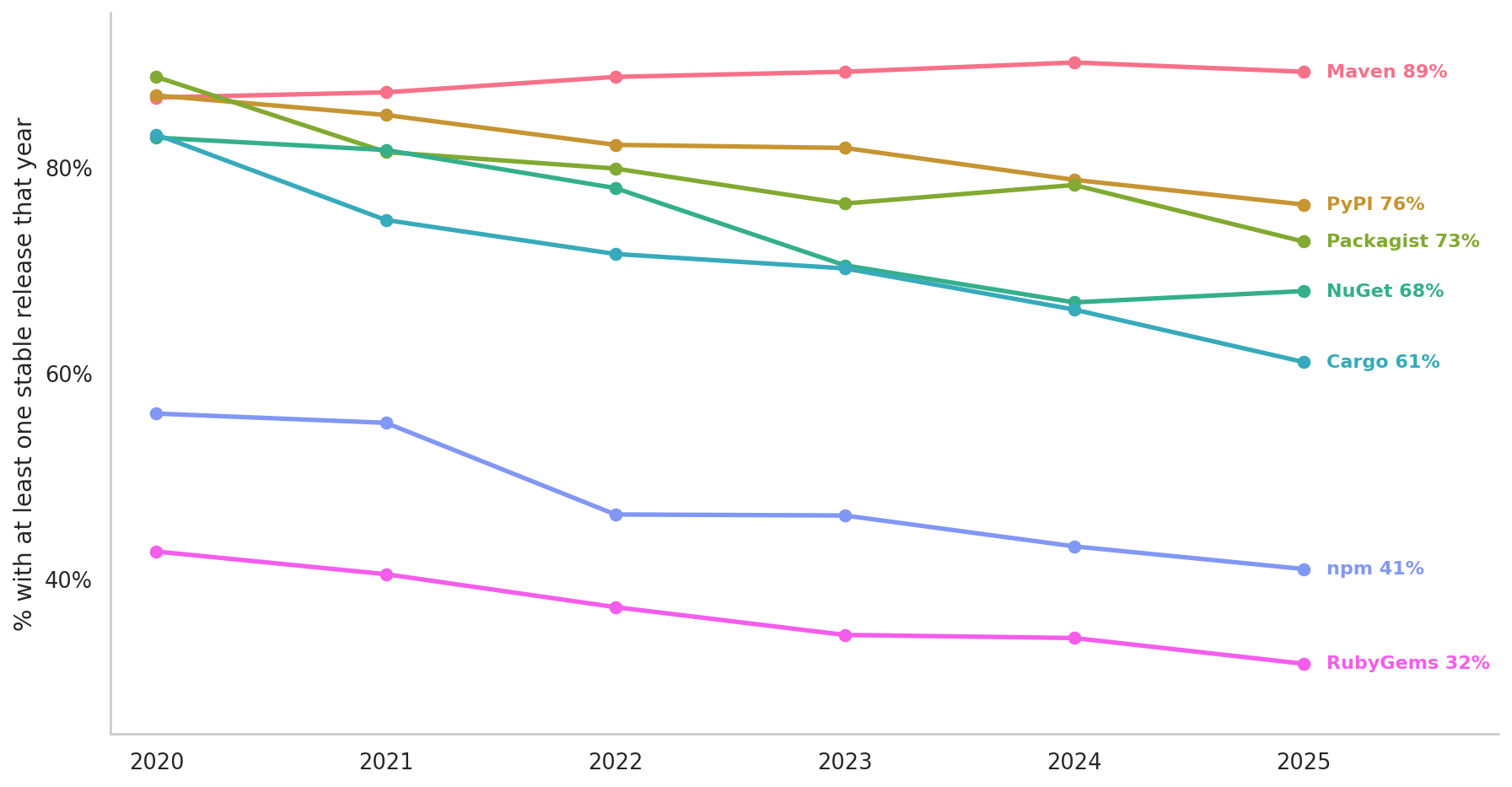
% of the pre-2020 cohort that released at least one stable version that year:
Just like in Finding 1, it's very stable. If anything, the trend is down. Not even half of the most popular RubyGems and npm packages release even once in a year.
This does not necessarily mean that the packages are abandoned. Some of the most-downloaded npm and Ruby packages are utility packages that are simply done like has-flag or multipart-post. They are still downloaded constantly, but they do not need yearly feature releases. Still, npm and RubyGems stand out: a large share of today's popular packages in those two ecosystems are not releasing regularly anymore.
Many argue that AI-assisted coding really took off and improved around the time when Opus 4.5 was released, back in November 2025.
If so, any change in release frequency would not be visible in the data we just looked at. Let's continue digging!
To see if Opus 4.5 and the other models released around that time have had any effect, we have to look at Q1 2026. Below is the same view as above, quarter by quarter for 2025 and Q1 2026. First, median stable releases per active package in each quarter:
| Registry | 2025 Q1 | 2025 Q2 | 2025 Q3 | 2025 Q4 | 2026 Q1 |
|---|---|---|---|---|---|
| Maven | 3 | 3 | 3 | 3 | 4 |
| PyPI | 2 | 2 | 2 | 2 | 2 |
| Packagist | 2 | 2 | 2 | 2 | 2 |
| NuGet | 3 | 3 | 3 | 2 | 3 |
| Cargo | 1 | 1 | 1 | 1 | 1 |
| npm | 2 | 2 | 2 | 2 | 2 |
| RubyGems | 1 | 2 | 2 | 2 | 2 |
And here is the percentage of the pre-2020 cohort that released at least once in each quarter:
| Registry | 2025 Q1 | 2025 Q2 | 2025 Q3 | 2025 Q4 | 2026 Q1 |
|---|---|---|---|---|---|
| Maven | 63% | 65% | 66% | 66% | 63% |
| PyPI | 49% | 48% | 44% | 49% | 47% |
| Packagist | 47% | 37% | 41% | 48% | 50% |
| NuGet | 49% | 46% | 43% | 55% | 51% |
| Cargo | 39% | 30% | 32% | 30% | 34% |
| npm | 22% | 19% | 24% | 21% | 25% |
| RubyGems | 17% | 14% | 13% | 18% | 15% |
"Unfortunately", just like what Finding 1 and Finding 2 showed for 2024-2025, release frequency did not increase even in Q1 2026. The only conclusion we can draw so far is that stable established packages have continued to release at a stable, predictable pace even over Q4 2025 and Q1 2026 with not much change.
Let's continue digging, something must have changed with AI, right?
Well-established packages created before 2020 are not releasing faster, but what about new packages? Maybe AI-assisted coding helps new packages release faster, while old and established ones are just stable and slow to change? Let's dig deeper into how different cohorts of packages behave.
Median releases in first 12 months for packages that reached today's top 1000:
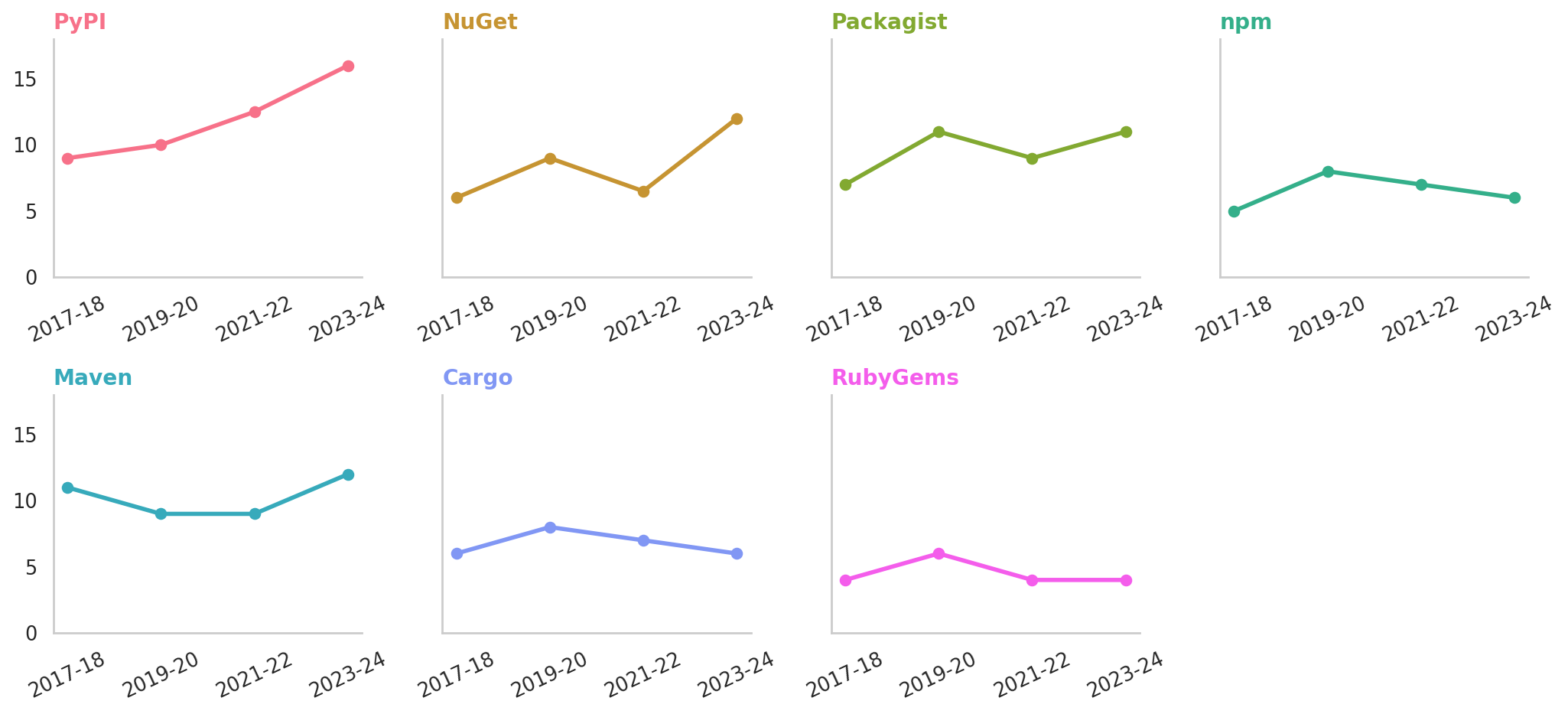
So here we have something, finally! Looking at new packages, one ecosystem really stands out: Python.
Can anyone guess what these fast-paced packages are about?
Let's look at the top packages on PyPI created in 2023/2024, ordered by number of releases during their first 12 months, and see if there is a pattern:
modal (978 first-year releases, serverless AI/cloud compute)litellm (786 first-year releases, LLM API proxy/router)langfuse (338 first-year releases, LLM observability)langsmith (173 first-year releases, LLM app observability)pydantic-ai-slim (169 first-year releases, AI agent framework)uv (155 first-year releases, Python package manager)langgraph (145 first-year releases, LLM agent workflows)langchain-core (130 first-year releases, LangChain primitives)With a single exception (uv, the excellent new Python package manager), the top 8 packages with the most releases in their first 12 months are all AI-related in one way or another. And they all put out a lot of new versions.
We can't say that the "normal" non-AI projects are releasing faster because of AI. At least not the core/popular packages. Instead they work as they always have, very stable!
But if we zoom in on AI-related packages, the picture changes. Those are developing fast, really fast!
To me the pace of innovation (and resulting package churn) in the Python AI ecosystem looks like how it was with all the JavaScript packages before React set the standard and took over. So anyone building AI in Python, be prepared to update (and very likely replace) your dependencies many times!